What is debt consolidation?
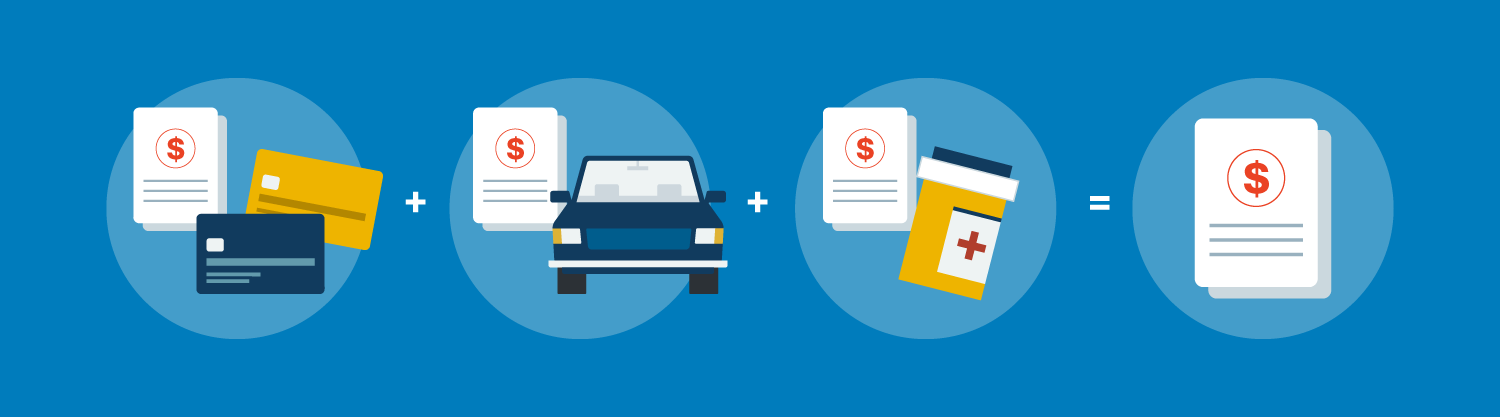
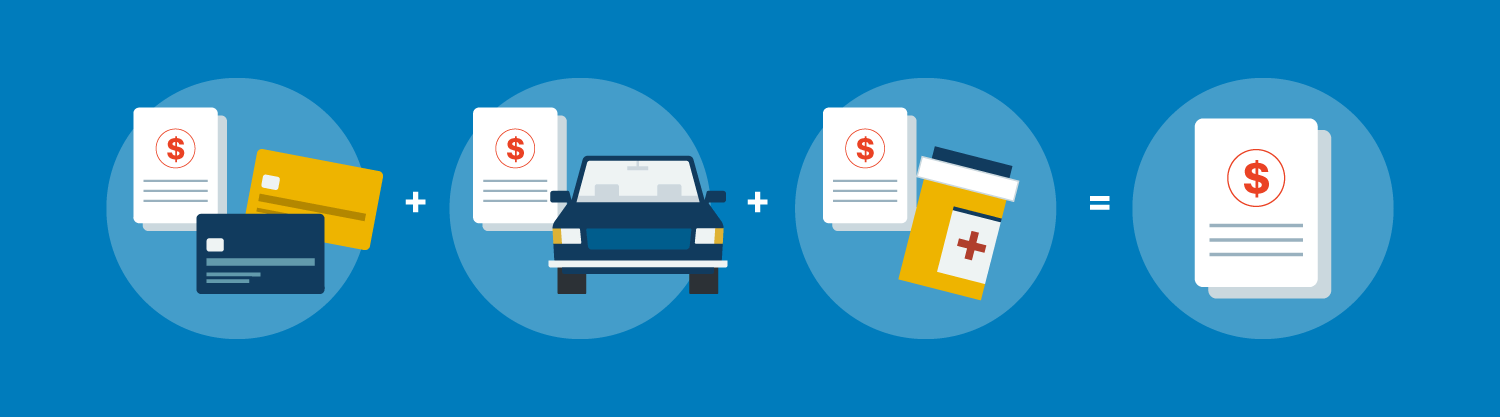
Debt consolidation is the process of refinancing multiple debts into a single payment, ideally with a lower interest rate. People often use debt consolidation to combine high-interest-rate credit cards—and sometimes loans or other debt—into one single monthly payment.[1]
It may be something to consider if you’re looking for an end goal or you’re financially overwhelmed. Sometimes people choose debt consolidation when their credit has improved, making them eligible to pay off high-interest debt cheaper and faster.
Debt consolidation loans and lines of credit like 0% APR balance transfer credit credits are common tools people use to consolidate existing debt. Other options include a home equity loan or a 401(k) loan, but these tend to be seen as riskier.[2]
How does debt consolidation work?
Debt consolidation works differently depending on the type of debt you’re consolidating and how you choose to consolidate it. For instance, let’s say you have three credit cards with a total balance of $15,000 and with an average interest rate of 27%. Maybe you’re making the minimum payment on each card or you’re able to swing a bit more, but either way, you’re not able to pay off your balances in full each month.
With a debt consolidation loan, you take out the loan and use the funds to pay off your cards. You’ll still have the $15,000 to repay, but instead of multiple card payments, now you just pay one lender back. Your monthly payment may be less than what you were paying for all three credit card payments, and you have an end date in sight for when all your debt will be paid off.[2]
That’s just one type of debt consolidation.
You could instead choose to transfer your high-interest balances to one 0% APR balance transfer credit card. These cards often come with long introductory offer periods ranging from 12 to 21 months. You won’t pay interest as long as you pay off the total balance within this time frame. While there’s typically a balance transfer fee, often 3% to 5% of the balance, you may save in the long run because of the 0% interest rate and quicker payoff timeline.[2]
What is a debt consolidation loan?
A debt consolidation loan is a type of unsecured fixed-rate installment loan that’s used to consolidate different types of debts. You may be able to qualify for a low interest rate based on your creditworthiness and financial situation. If the rate is fixed, your monthly payments and interest costs will be predictable over the life of the loan.[1][2]
You can use the money from a debt consolidation loan to cover most kinds of debt. So, if you have several types of debt, like medical bills, credit cards, or even another personal loan you want to refinance, you can consolidate them all into your new debt consolidation loan. However, it’s important to note that some debts, like student loans, cannot be consolidated with this type of personal loan.[2]
To avoid a hit to your credit when shopping around for loans, look for lenders that allow you to check your rate. With Happen Bank, formerly LendingClub, checking your rate has no impact on your credit score because we use a soft credit pull.
How debt consolidation may help you save money
To figure out how much you’d potentially save through debt consolidation, calculate your potential interest costs. For instance, you could take out a debt consolidation loan to pay off the $15,000 in credit card debt we mentioned earlier. Taking out a loan for $15,000 with a 14% interest rate and three-year term would save you nearly $1,700 compared to paying down the cards directly.
Here’s a look at how the monthly payment, payoff timeline, and total interest costs compare.
Creditor/lender information | Credit cards | Debt consolidation loan |
Amount owed (principal) | $15,000 | $15,000 |
Interest rate | 27% (average APR) | 14% |
Monthly payment | $750 (minimum payment) | $512.66 |
Time to pay off | 2 years and 3 months | 3 years |
Total interest paid | $5,151.26 | $3,455.92 |
Total amount saved | – | $1,695.34 |
Pros and cons of debt consolidation
Weigh the pros and cons carefully if you’re considering debt consolidation. The specifics may vary depending on the loan you’re using and the types of debt you’re consolidating.[2]
Pros of debt consolidation | Cons of debt consolidation |
May lower the interest rate on your debt[1] | May require good credit[1] |
May lower your monthly payments[1] | A fixed repayment term could take longer to repay[1] |
Streamlines multiple monthly payments into one[1] | Might increase the risk of losing collateral, depending on loan type[1] |
May help improve your credit score if you don’t add new credit card debt[1] | May charge fees[1] |
When is debt consolidation a good idea?
Consolidating your debts could make sense when it helps you save money or makes managing your finances easier. Here are some scenarios when debt consolidation is a good idea.
You may save money
If you get a loan offer with a lower interest rate than you’re currently paying, consolidating the debt could save you money overall.
You may have several loan offers to choose from, and you can decide what’s best based on your goals. Generally, a shorter repayment period can lead to the most savings, but it will also have the highest monthly payments.
You want fewer payments
Combining multiple monthly loan payments into a single payment could make planning your monthly finances easier. Sometimes, even if it doesn’t lead to significant savings, consolidation could be helpful as a debt management tool.
You want lower monthly payments
Consolidation may also help lower your monthly payments, especially if you choose a loan offer with a long repayment period. Even if your loan has a lower interest rate, longer loan terms may lead to paying more interest overall. But it could be a worthwhile trade-off to free up extra money in your monthly budget.
When shouldn’t you consolidate debt?
If you don’t qualify for a loan with a lower interest rate or monthly payment, then you may not want to consolidate your debts right now. Additionally, there are a few more scenarios when consolidation isn’t ideal, even if you can lower your interest rate.
You’re close to paying off your debt
When you’re only a few months away from paying off the debt, staying the course could be the best option. Once you factor in a debt consolidation loan’s origination fee or a credit card balance transfer fee, you might wind up spending more overall, even if you lower your interest rate.
You don’t want to take on more risk
The savings might not be worth the added risk if you’re considering using a secured loan, such as a mortgage-backed loan, to consolidate unsecured debts. Similarly, even if it saves you money in the short term, using a private student loan to refinance and consolidate federal student loans could lead to more risk because you’ll lose access to federal benefits.
If you might wind up getting deeper into debt
Consolidating high-interest credit card debt can be a productive step toward getting out of debt. However, consider why you have credit card balances in the first place. If it’s primarily from overspending, freeing up your credit limits could lead to more overspending and more overall debt.
Does debt consolidation hurt your credit score?
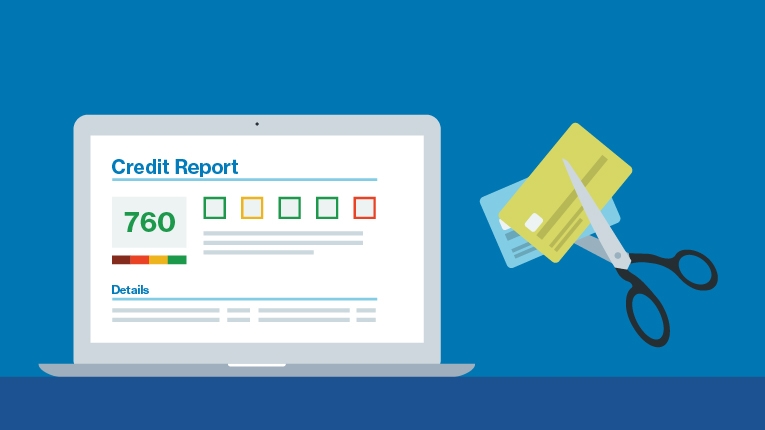
Your creditworthiness (as well as your debt-to-income ratio) plays a large role in the interest rate you’ll receive for a debt consolidation loan or 0% APR balance transfer credit card. While you may be able to still qualify with less-than-perfect credit, you won’t save as much as you would if your credit is excellent. People with excellent credit (740 and higher) typically receive the best interest rates and terms, meaning they’ll likely benefit most from debt consolidation.[3]
Before applying, remember that obtaining a new line of credit may cause your credit score to decrease temporarily. However, in time, consolidating credit card debt with a debt consolidation loan, like a Happen Bank personal loan, may actually increase your credit score by lowering your credit utilization ratio. Additionally, your on-time payments could be added to your credit reports and help improve your credit.
The bottom line
Debt consolidation may be a good choice for people who want to streamline payments to creditors into one easy-to-manage monthly payment and save on interest. However, before deciding to consolidate your debt, it’s important to consider your financial situation, creditworthiness, and how much debt you have left to pay back.
If you do decide to consolidate debt with a debt consolidation loan, 0% APR balance transfer credit card, or another method, be sure to compare offers from different lenders and creditors, ideally with financial institutions that let you check rates without a hit to your credit score.
Consumer Financial Protection Bureau. “What do I need to know about consolidating my credit card debt?”
Consumer Financial Protection Bureau. “What is the difference between credit counseling and debt settlement, debt consolidation, or credit repair?”
Consumer Financial Protection Bureau. “What is the difference between a loan interest rate and the APR?”
You May Also Like