APR vs. APY: What’s the difference?
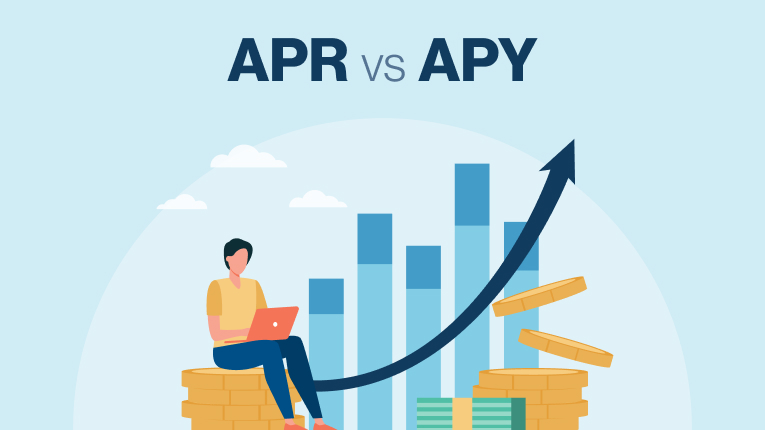
The terms annual percentage rate (APR) and annual percentage yield (APY) may sound the same, but they’re quite different.
While APR is generally used to determine the cost of borrowing (for example, on a loan or credit card), APY is used to calculate how much you earn when saving or investing money.
Understanding how APR and APY are used and calculated can help you make better financial decisions, particularly when you’re comparing loans, credit cards, savings, and investment products.
What is APR?
The annual percentage rate (APR) of a loan or credit card is the total annual cost to borrow money, including fees, expressed as a percentage. APR is expressed as a percentage to make it easier to compare the cost of credit.
An APR may be either fixed or variable. A fixed APR generally remains the same for the life of the loan. A variable APR means the interest rate is tied to an underlying index — such as the federal prime rate — and the rate may increase or decrease over time based on market conditions. (For example, most credit cards have variable APRs.)
With loans, APR generally includes the interest rate plus any fees or other finance charges that are part of the loan agreement.
For example, a $10,000 loan with a 10% rate of interest, a 1% origination fee, and 5-year loan term has an APR of 10.43%.
With credit cards, the APR and the interest rate are generally the same because the fees you may pay (such as annual fees, foreign transaction fees and balance transfer fees) are not typically included in the APR calculation. And unlike loans, credit cards have several APRs that may apply to different transactions or account activities, depending on how you use them.
For example, credit cards have APRs for purchases, introductory offers, balance transfers, cash advances, and even penalties.
How to calculate APR
Calculating the APR for a credit card is simple because it’s typically the same as the card’s interest rate. But with some loans, including mortgage, auto, personal and student loans, the interest rate and the APR can be different as typically there are other fees and charges involved. The basic formula to calculate APR is:
APR = ((Fees + Interest/Principal)/n) x 365 x 100
n = number of days in the loan term
The steps to calculate APR are:
Find the interest charges over the life of the loan
Add the fees
Divide the sum by the principal balance of the loan
Divide by the number of days in the loan’s repayment term
Multiply by 365
Multiply by 100 (to convert it to a percentage)
What is APY?
The annual percentage yield (APY) is a measure of the total amount of interest earned on an interest-bearing account based on the interest rate and frequency of compounding over one year, expressed as a percentage.
APY is expressed as a percentage to make it easier to compare interest-bearing financial products, as a checking account, savings account, or certificate of deposit.Compounding interest is when interest accrues (daily, weekly, monthly, quarterly, or annually depending on the account) on both the principal balance and on the interest that has accrued in previous compounding periods. As a result, the APY on a deposit account is generally a bit higher than the interest rate.
How to calculate APY
The steps for calculating APY are relatively simple, but you may need a calculator.The basic formula to calculate APY is:APY = (1 + r/n)n – 1The steps to calculate APY are:
Convert the interest rate into decimal form. For example, a 1% interest rate would be expressed as 0.01
Divide the rate by the number of compounding periods each year
Add that figure and 1
Take the sum to the power of the number of compounding periods each year
Subtract 1
APR vs. APY: How compounding differs
One of the biggest differences between APY and APR is that APY takes into consideration compounding interest while, generally, APR does not.
When it comes to saving, compounding interest is beneficial because you earn interest on both the money you’ve saved and on the interest you’ve earned, which means your money grows more quickly. The calculation for APY accounts for this “interest on interest” earning.
For a simple compounding interest example, let’s say you save $1,000 (your principal) and it earns 5% interest (your earnings) once a year (the compounding frequency).
After the first year, you would have $1,050 – your original principal, plus 5 percent, or $50. The second year, you would have $1,102.50. That’s because the next interest payment equals 5 percent of $1,050, or $52.50.So, your savings account, CD, or other interest-bearing accounts earn interest on interest, accelerating the growth of those balances over time.
APY calculates what your return, or earnings, would be on an annual basis as a percentage. And when you compare APYs for different deposit savings products, those numbers reflect compounding interest.
On the other hand, APRs generally don’t take into account compounding interest. For example, most loan APRs use simple interest in their calculations, which means you pay interest only on the principal balance, and (with a few exceptions for loan forbearance or deferment) interest doesn’t compound.
With credit cards, it’s a little different. If you don’t pay off your balance in full each month, you’ll be charged interest on the unpaid balance, and interest will start to accrue on any new purchases from the transaction date until your balance is paid in full. Any accruing interest is compounded daily, however, credit card APRs don’t reflect this type of compounding.
The bottom line
APYs and APRs are similar in that they’re used to calculate interest, but how they’re calculated and when they’re applied sets them apart. APRs are typically used when calculating how much interest you pay each year on a credit card or loan, and APYs are used to determine how much interest you earn on an interest-bearing bank account or investment in a year. APYs usually include a compounding element, while APRs generally don’t.
Understanding how APR and APY are calculated and how much you may pay or earn when they’re applied to your account balances can help you better compare financial products.
You May Also Like